•Meanwhile in markets, things are going from bad to worse in the Iran war. Oil prices have duly responded, with Brent crude futures approaching the March 2 panic highs;
•At pixel time, Brent crude traded just north of $113 a barrel, up from around $100 a barrel because of the escalation overnight. For the record: the March 2 panic high was $119,50 a barrel;
•In the latest and greatest from the war, President Trump threatened to obliterate Iran’s key South Pars gas field in retaliation for the Iranian missile strike Qatar’s key gas facility at Ras Laffan yesterday. At the same time, a split with the Israelis emerged, with the President saying he knew nothing of Israel’s attack on Iran’s South Pars gas field on Wednesday night. He said that the Israelis won’t hit the gas field again unless the Iranians “unwisely decides to attack” another nation. Obviously, it’s very hard for Tehran not to keep attacking Gulf Nations, its strategy from day one. Tehran’s thinking is that the Gulf nations will pressure the US to back off. Or even join the war, but with a twist. According to an insightful comment on Al Jazeera, President Trump might very well decide to pull back once the Gulf nations become embroiled, leaving it up to them to clear up the mess he has created. That’s cynical Realpolitik for you;
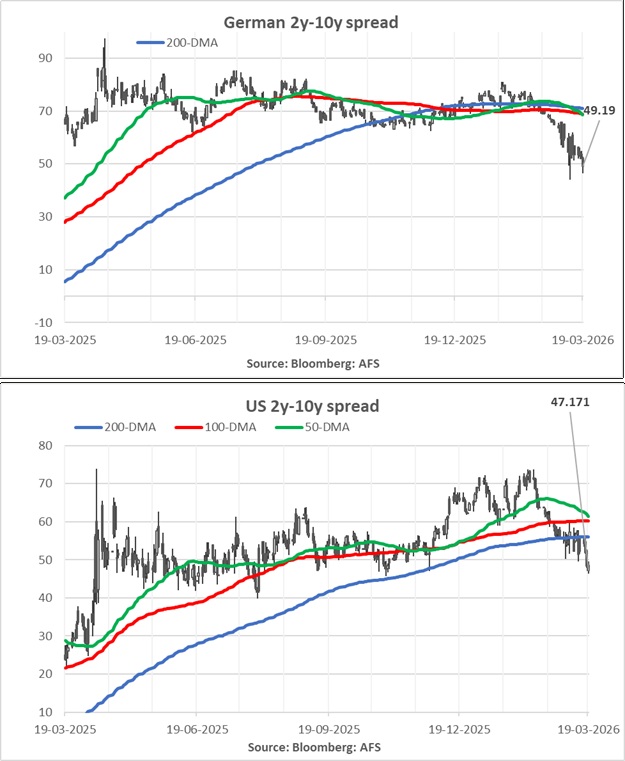
•Turning to some market commentary, bonds and equities are predictably lower on the latest energy price spike, which, by the way, has also boosted natural gas prices by ten percent this morning. However, a new pattern is emerging in the bond market: the recession trade. Since the outbreak of the war, Bund and UST curves have bear-steepened, with strong yield increases across the curve. But what we see now, is that the increases in long end yields have either slowed (USTs) or partially reversed (in the case of Bunds). Bund and UST 2y10y curve spreads have broken out to the downside, with both trading at 50bps or thereabout. There’s still a long way to go to inversion though. But at this pace of short end yield increases, give it a few weeks and the headlines on flipped yield curves and recession warnings will be all over the headlines;
•With oil prices at the highs of the day, S&P 500 futures remain stuck at the lows of the day. What’s more, the S&P 500, which had nothing left to go on except last year’s rally (which was getting long in the tooth), started to break out to the downside. At the 200-DMA at 6,600 there should be support though. But clearly, we’re on Iran war shock away from a big move down;
•Asian equities are suffering stiff losses this morning, with the Nikkei (-3.5%) hit hardest. The broad dollar has resumed its rally, but with an almost 2% gain from the pre-war lows, we’ve only returned to late 2025 levels. Ahead of the Swiss National Bank meeting this morning, EURCHF has inched up further, and at snail’s pace we’re moving away from the 0.90 pain level (for the SNB that is);
•USDJPY is off the high of nearly 160, trading at 159.38 last after Bank of Japan Governor Ueda gave the slightest hint that the central bank could hike rates next month (today’s decision was a hold) because of the energy price shock. Before his remarks, BOJ-dated TONARs had priced in about 15bps of hikes for the next meeting;
•Looking ahead, it’s central bank meeting galore today, though all five central bank decisions (SNB, Riksbank, BOE, ECB, Czech National Bank) should be a hold. Predictably, markets will be watching closely for clues on central bankers’ appetite to tighten policy in face of a negative supply shock. Ironically, most of these central banks were neutral or leaning towards cutting before the war – no one’s heart was with a tightening cycle. Now, they’re forced to contemplate rate hikes that they don’t want because of weak labor markets. All because of a war that Trump wanted to have wrapped up by now.