



• Meanwhile in markets, since Gulf Cooperation Council sovereign bonds have been unperturbed by the breakdown of the US-Iran Memorandum of Understanding, should you worry about the ongoing tensions and the closure of the Strait of Hormuz? Probably not;
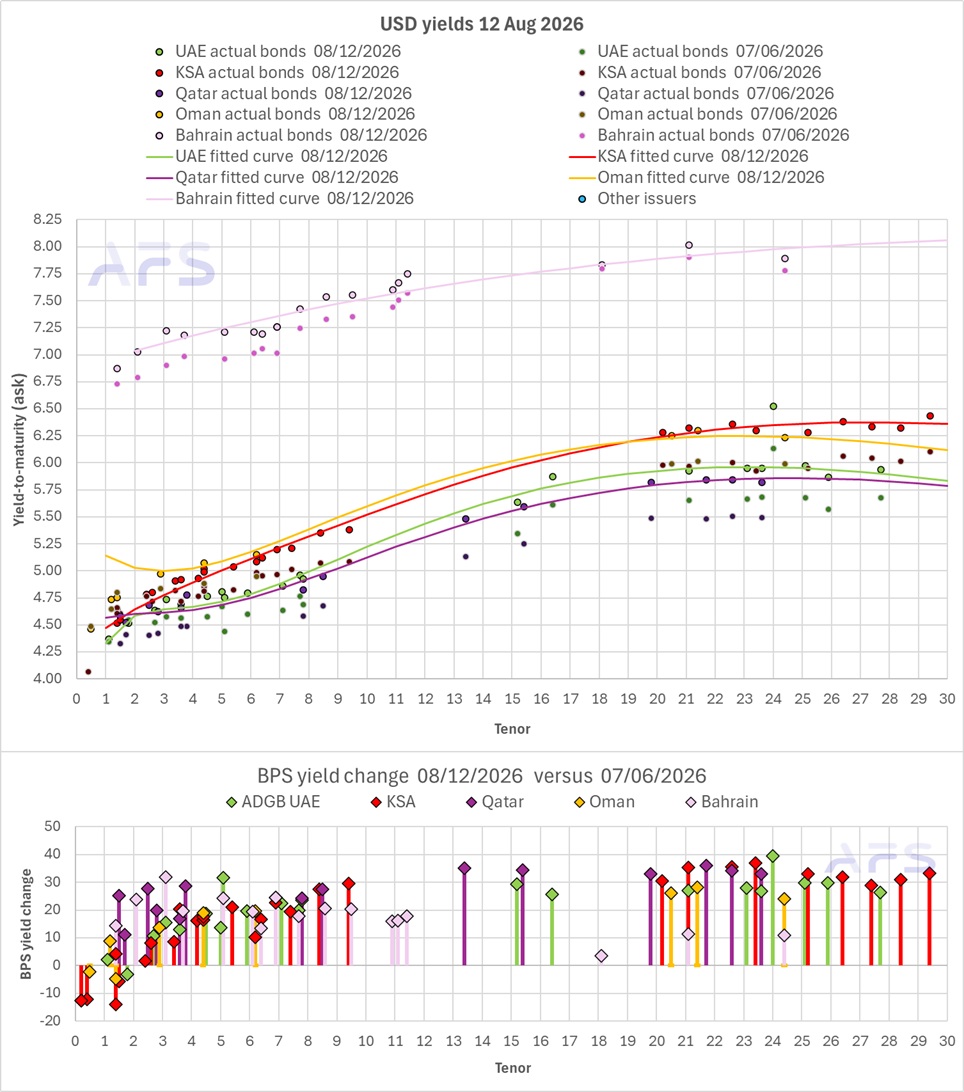
• Since July 6-7, when Iran attacked commercial ships that transited the western route in the Strait of Hormuz along the Omani coast triggering a string of tit-for-tat strikes with the US, GCC USD denominated bond yields are up 10-30bps across the curve. A few long end outliers rose by a couple of bps more than that. Since early July, UST Treasury yields are up 10-25bps across a bear-steepening curve. At the same time, Brent crude futures prices have risen from barely $70 a barrel to $100 a barrel before falling to $89 a barrel as tit-for-tat strikes have ended (or are on hold);
• Notably, Bahraini and Qatari bonds have generally underperformed, though the underperformance doesn’t apply to every bond of both nations. Most Saudi bonds have outperformed in general, though the spread with lower rated Omani bonds remains very tight. Since the outbreak of war last winter, Omani bonds have outperformed their GCC counterparts by a wide margin. Conversely, Bahrain, the lowest rated GCC sovereign, has seen its bonds underperform strongly;
• Seemingly, the modest differences in bond performance between the GCC states over the summer cannot be explained by geopolitical positioning. In the joint July 23 statement, GCC nations were in unison on condemning Iranian attacks on their infrastructure. Furthermore, repeated attempts by both Oman and Qatar to mediate between Washington and Tehran do not appear to have affected their bonds’ performance;
• Based on a simple regression where the credit rating is the sole independent variable to explain spreads over US Treasuries, Bahraini 5y bonds trade at a discount of 60bps given its single B rating. Qatari bonds have also cheapened, with a 30bps discount given its double A credit rating. At the same time, Omani bonds trade at a premium of no less than 80bps for its triple B rating;
• To conclude, the Iran war hasn’t led to a stampede out of GCC bonds. In fact, Omani bonds have seen their spreads with USTs narrow. No surprise as it’s the only GCC nation that has managed to stay out of the carnage of war most of the time without breaking away from its alliance with the other Gulf nations or the US;
• Turning to some market commentary, in one of those sudden spontaneous moves, UST yields moved lower while the yen strengthened and equities rose later in the morning. With the downtick in USDJPY from 159.3 to 158.6 being the first significant move, I suspected yentervention. However, Brent crude futures ticking lower while equities rose point to positive Iran war headlines out there somewhere. That somewhere being the Turkish AA newswire running an unconfirmed story of a sixty-day extension of the US-Iran ceasefire. Which was kind of already in place – in the case you noticed the recent lack of airstrikes;
• Looking ahead, eyes will be on the US CPI release out at the usual time (14:30 CET). Core expected to have eased to 2.5% in July from 2.6% in June. 2.5% would be the joint lowest reading since the pandemic, but don’t let that fact fool you. The Fed’s preferred price gauge, PCE core, is tracking at 3.3% for July. Meaning that the Fed’s inflation headache is far from over.

.png)